I went to a number of excellent sessions, some in Second Life and some in the Opensim grid Avacon. I also hadn't spent much time in an opensim in several years, and I have to say it's much improved, though still a few years behind Second Life. (Of course, I do admit that some of that could simply be my level of skill with Opensim!)
Even so, from this year's conference, I could tell that the work in and excitement surrounding the use of virtual environments has escalated. The last few years have been rather bleak in many ways for teaching in world--from Linden Lab's abandonment of support for educational institutions (though it has been reestablished), to the larger culture's gaze at MOOCs as the shiny new thing (until the success rates of single digits became known!), to the adoption of mobile devices as the go-to place for online engagement especially among young people. But now with the feverish hyping of virtual reality head sets (I have a Google alert for "virtual reality" and get a dozen + hits a day) and the growth of Minecraft, it seems that recognizing the value of virtual environments in education is beginning to rise out of the trough of disillusionment in the hype cycle that Gartner has been publishing for the last few years. I heard, in fact, during the conference that in Virginia virtual worlds are now a required part of the tech standards that students need to fulfill in K-12.
So here are some notes about sessions I attended:
Virtual Worlds and Transactional Distance in Higher Education Online Courses – a Student Panel

Of course, this was something that really interested me since I experienced much the same thing when first interacting with others in Second Life. There was much more a sense of being with others than I had experienced in 2D web interactions.
Ebbe Linden speech
 The CEO of Linden Lab spoke for an hour giving educators an update on the improvements taking place in Second Life (most interesting to me, an upgraded browser in media on a prim), and on the development of Sansar (or as some call it SL2). He stated that both platforms will be operating separately for years, that SL users will likely find Sansar not as feature rich as they are used to (which prompted me to question in chat why then would we be compelled to move--which was not answered), but that it would ultimately have in-world building capability, though initial building will take place with third-party programs.
Here's a video of the talk presented on Daniel Voyager's blog if you'd like to see it. And here is a more robust summary on Jo Yardley's blog.
OpenSimulator Featured Panel at Avacon and Stephen Downes' keynote
As I mentioned above, this is the first time I've spent any time in opensim grids in several years. I have avatars in Jokaydia grid, Third Rock and OS Grid. Only the latter would allow me to hypergrid to Avacon, and it worked great.
The sessions went smoothly, though I can't say I'm a fan of Teamspeak as a separate voice platform, even though, to be fair, it worked fine. And no shadows--everything looked much flatter than in SL, but again that could be because I'm not familiar with any particular settings I should have set up.
It was great hearing from the featured panel about the projects being worked on in opensim grids by educators, and about the problems and improvements that are needed (primarily focused on communicating with others what they are doing--quite a shout out to Google+ by the way--and smoother hypergridding). And Downes' keynote was interesting, though I'll just give you a link rather than noting any take aways, mainly because I was struck more with the venue than what was said.
If hypergridding becomes as smooth as teleporting in SL and if the number of events/exhibits become readily available for writers and undergraduate scholars, I would seriously consider moving.
 Kapp's keynote was entitled "Reaching the Engagement Horizon in Virtual Worlds: Crafting Engagement Through Games and Gamification." I've never been a fan of gamification, but his work that he presented was intriguing. Though rather ironic--his main point is that active learning and activities is the best way to learn in virtual worlds, as he lectured at us for an hour!
He noted that when we use 2D web communication like Skype, we are very aware that all participants are in different locations, that there is a distance between us--we can hear sounds from different places and/or see images from different rooms or venues. However when we meet in virtual worlds, we are in the same place doing the same thing.
This is something I've long noticed about virtual worlds, that when avatars meet, there is an intimacy (a word that came up during the conference that I had never thought of but is quite apt) that arises, a sense of person, that does not take place in 2D conferencing venues. Don't get me wrong--2D communication through audio and video is great, but the disembodied heads floating on a screen separates rather than brings together participants. The placeness of virtual worlds creates connection that I've still yet to be able to explain.
One other take away: We learn from games not because they are fun, but because they are interactive. (Though it seems to me that fun does motivate game playing! If it's not fun, players won't interact!)
At the student panel, I had asked them the part that a sense of place contributed to their choice of 3D or 2D meetings. At first they didn't quite get what I was asking, but they mentioned that Second Life was more fun, and not in the sense that they were playing a game, but more so that just seeing others in different avatars, in different environments, was much enjoyable, lightening the very serious work that they were doing as a class.
 The week prior, I had my creative writing students go on a field trip. They were studying setting in fiction, and I asked them to go find sims that corresponded with their settings they had been creating in stories and poems. One group came back with animal balloons; they had visited a zoo sim and were quite excited about the animals (and balloons) they had discovered.
So I'm still not sure how far I'd want to go with gamification, though I think definitely a sense of play at some level is valuable with learning, and I've found that interaction and fun are definitely valuable with online courses in virtual environments.
There were other excellent sessions, and it was great to hear what has been going on with the Virtual Pioneers and Caledon Oxbridge, but this blog entry has gotten long enough so I think I'll stop here.
One other thing, though--in the process of participating in VWBPE, I learned about, and tried, a couple of other virtual worlds, Edorable and High Fidelity. Both are not ready for prime time (not even for late night) but were intriguing to check out. The developer of Edorable claims that his media board is entirely synchronous, that what the instructor does on the board is seen by the students, just like in a face to face classroom--even with password protected sites. This sounds quite promising!
Now, really, I'm done. I guess that's what you get when I haven't blogged in a while!
The sessions went smoothly, though I can't say I'm a fan of Teamspeak as a separate voice platform, even though, to be fair, it worked fine. And no shadows--everything looked much flatter than in SL, but again that could be because I'm not familiar with any particular settings I should have set up.
It was great hearing from the featured panel about the projects being worked on in opensim grids by educators, and about the problems and improvements that are needed (primarily focused on communicating with others what they are doing--quite a shout out to Google+ by the way--and smoother hypergridding). And Downes' keynote was interesting, though I'll just give you a link rather than noting any take aways, mainly because I was struck more with the venue than what was said.
If hypergridding becomes as smooth as teleporting in SL and if the number of events/exhibits become readily available for writers and undergraduate scholars, I would seriously consider moving.
Karl Kapp keynote
 Kapp's keynote was entitled "Reaching the Engagement Horizon in Virtual Worlds: Crafting Engagement Through Games and Gamification." I've never been a fan of gamification, but his work that he presented was intriguing. Though rather ironic--his main point is that active learning and activities is the best way to learn in virtual worlds, as he lectured at us for an hour!
A couple take aways:
This is something I've long noticed about virtual worlds, that when avatars meet, there is an intimacy (a word that came up during the conference that I had never thought of but is quite apt) that arises, a sense of person, that does not take place in 2D conferencing venues. Don't get me wrong--2D communication through audio and video is great, but the disembodied heads floating on a screen separates rather than brings together participants. The placeness of virtual worlds creates connection that I've still yet to be able to explain.
One other take away: We learn from games not because they are fun, but because they are interactive. (Though it seems to me that fun does motivate game playing! If it's not fun, players won't interact!)
At the student panel, I had asked them the part that a sense of place contributed to their choice of 3D or 2D meetings. At first they didn't quite get what I was asking, but they mentioned that Second Life was more fun, and not in the sense that they were playing a game, but more so that just seeing others in different avatars, in different environments, was much enjoyable, lightening the very serious work that they were doing as a class.
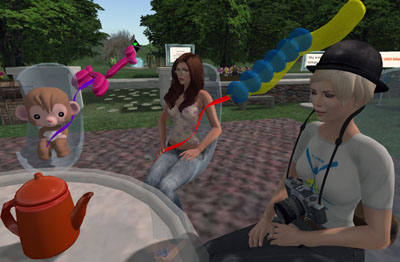 The week prior, I had my creative writing students go on a field trip. They were studying setting in fiction, and I asked them to go find sims that corresponded with their settings they had been creating in stories and poems. One group came back with animal balloons; they had visited a zoo sim and were quite excited about the animals (and balloons) they had discovered.
So I'm still not sure how far I'd want to go with gamification, though I think definitely a sense of play at some level is valuable with learning, and I've found that interaction and fun are definitely valuable with online courses in virtual environments.
There were other excellent sessions, and it was great to hear what has been going on with the Virtual Pioneers and Caledon Oxbridge, but this blog entry has gotten long enough so I think I'll stop here.
One other thing, though--in the process of participating in VWBPE, I learned about, and tried, a couple of other virtual worlds, Edorable and High Fidelity. Both are not ready for prime time (not even for late night) but were intriguing to check out. The developer of Edorable claims that his media board is entirely synchronous, that what the instructor does on the board is seen by the students, just like in a face to face classroom--even with password protected sites. This sounds quite promising!
Now, really, I'm done. I guess that's what you get when I haven't blogged in a while!


