Showing posts with label 3D environments. Show all posts

Saturday, February 03, 2018

High Impact Practices in an online class

Inside Higher Ed published an article recently entitled "Making an Impact in Online Courses," a report on a session at the annual Association of American Colleges and Universities conference at Washington, D.C. (a professional organization who advocates for the inclusion of liberal arts in all aspects of higher education).
The focus was on the incorporation of high-impact practices, an AAC&U term that incorporates researched activities that have proven to enhance student learning, such as learning communities, writing-intensive courses or collaborative assignments and projects.
The three member panel from Mary Washington University, McDaniel College, and St. Edward's University discussed a variety of projects and practices, mostly focused on encouraging students to write, and collaborate, and interview people in their communities.

Sounds good, though--as I experienced when attending this conference a couple years ago--as someone who has taught online for decades, I found much discussed obvious--for example, one professor mentioned how much better participation in interviewing became when she first had students submit a proposal about who to interview.
So, good stuff, and if you're new to online learning, helpful to recognize some things that are helpful when teaching in that venue. However, most of it is asynchronous, even though interactive at some level, disembodied, and substantially lacking in presence among students or with the professor.
At the end of the article, one participant brought up something that was quite interesting:
Jesse Stommel, executive director of the division of teaching and learning technologies at Mary Washington, said ... that he wants to see informal, self-motivated discussions considered as a high-impact practice of sorts. In his face-to-face classes, he sometimes starts class by asking how students spent their weekends, and students sometimes approach him after class for free-flowing conversations that last 10 minutes or more. 
He thinks creating an environment where similar spontaneity can flourish would make a high impact as well.
It brought me back to a conversation I had years ago with a colleague who had tried teaching online, and did so for several semesters, but then gave it up and went back to face-to-face teaching. He told me that he missed the informal interaction with students, being able to joke around, talk about their weekend, the give and take that he saw and enjoyed in a real-time, f2f environment. This lack is exactly what Stommel seems to be decrying and suggesting is as integral to an educational experience as other high-impact practices.
My observation is that when we limit online learning to asynchronous 2D, text-based environments, we lose that spontaneity, that opportunity to create community with students where more informal, though vital, interaction can take place. Yes, we can create a simulation of informality through our emails, or assignment language, or syllabus. We can jump into discussion forums and interact with students asynchronously. We can even do some real-time text chat, or even audio, or even video conferencing that helps some. But notice that none of that real-time getting together as a learning community was mentioned in the article, and rarely is with online classes.
Our campus is no different at Lansing Community College. We've had online classes, online degrees offered since 1997 (as I've mentioned some years ago in this blog). But the push has always been asynchronous, with very little recognition of the value of synchronous interaction.
For the last eight years, I've been using Second Life with my online classes, where we meet as a whole class once a week. It operates just like f2f meetings. We talk about our weekends, movies, the weather before class. We work as a whole class, in groups, do peer review, writing exercises, visit sims related to their work (especially for the creative writing students where they are able to interact with other poets, fiction writers, storytellers in world). We are doing Stommel's high-impact practice.
Is it perfect? Of course not, any more than f2f interaction is. But with embodied avatars operating in a 3D space, students can see a representation of each other, work together in a place (rather than a computer 2D window), hear each other and participate in a learning community each week; I've seen (as have others) "an environment where similar spontaneity can flourish" as it can in a classroom on campus.
But it's difficult with little support from administration. I'm allowed to teach this way in online classes. But I'm on my own. I have no technical support, and the ability to get what I do (Is it an online class? Is it a hybrid class? Is it an online but hybrid class? What is it?) has been difficult to comprehend by overworked staff, administration, even academic advisers. And explaining it as an overworked professor! I've not had the time, or energy, to promote as I could, and even if I did, I'm not sure it would do much good. Online=asynchronous learning to many--students, staff, faculty and administration.
It's really a shame. Because with 3D environments, the experience that online students have could be so much more. Sure, they can still learn in a 2D learning management system like Blackboard and Desire2Learn, and such is integral to my class. But that spontaneous interaction--as my colleague put it, the ability to joke around--is largely missing, and there is no good reason, today, for such to be the case in online learning.

Sunday, March 13, 2016

Some notes on the Virtual Worlds Best Practices in Education conference

I haven't attended the VWBPE conference in a couple years (or at least not much beyond a session or two), but since this year it fell on my spring break, I decided that I should do so.

I went to a number of excellent sessions, some in Second Life and some in the Opensim grid Avacon. I also hadn't spent much time in an opensim in several years, and I have to say it's much improved, though still a few years behind Second Life. (Of course, I do admit that some of that could simply be my level of skill with Opensim!)

Even so, from this year's conference, I could tell that the work in and excitement surrounding the use of virtual environments has escalated. The last few years have been rather bleak in many ways for teaching in world--from Linden Lab's abandonment of support for educational institutions (though it has been reestablished), to the larger culture's gaze at MOOCs as the shiny new thing (until the success rates of single digits became known!), to the adoption of mobile devices as the go-to place for online engagement especially among young people. But now with the feverish hyping of virtual reality head sets (I have a Google alert for "virtual reality" and get a dozen + hits a day) and the growth of Minecraft, it seems that recognizing the value of virtual environments in education is beginning to rise out of the trough of disillusionment in the hype cycle that Gartner has been publishing for the last few years. I heard, in fact, during the conference that in Virginia virtual worlds are now a required part of the tech standards that students need to fulfill in K-12.

So here are some notes about sessions I attended:

Virtual Worlds and Transactional Distance in Higher Education Online Courses – a Student Panel

This was my favorite session, where online students discussed their experience with using Second Life as a class meeting place during their online course. During the beginning of the course, the professor had them try a session in a virtual web conference program and then one in Second Life. They then chose which to continue meeting in. They all chose Second Life, and apparently this has been the overwhelming choice for a number of sections. The reasons that the students selected the virtual environment was because they felt like they were in a class with other students and the professor, rather than the more flat (their word) experience of talking heads in a web conference.

Of course, this was something that really interested me since I experienced much the same thing when first interacting with others in Second Life. There was much more a sense of being with others than I had experienced in 2D web interactions.

Ebbe Linden speech

The CEO of Linden Lab spoke for an hour giving educators an update on the improvements taking place in Second Life (most interesting to me, an upgraded browser in media on a prim), and on the development of Sansar (or as some call it SL2). He stated that both platforms will be operating separately for years, that SL users will likely find Sansar not as feature rich as they are used to (which prompted me to question in chat why then would we be compelled to move--which was not answered), but that it would ultimately have in-world building capability, though initial building will take place with third-party programs.

Here's a video of the talk presented on Daniel Voyager's blog if you'd like to see it. And here is a more robust summary on Jo Yardley's blog.

OpenSimulator Featured Panel at Avacon and Stephen Downes' keynote

As I mentioned above, this is the first time I've spent any time in opensim grids in several years. I have avatars in Jokaydia grid, Third Rock and OS Grid. Only the latter would allow me to hypergrid to Avacon, and it worked great.

The sessions went smoothly, though I can't say I'm a fan of Teamspeak as a separate voice platform, even though, to be fair, it worked fine. And no shadows--everything looked much flatter than in SL, but again that could be because I'm not familiar with any particular settings I should have set up.

It was great hearing from the featured panel about the projects being worked on in opensim grids by educators, and about the problems and improvements that are needed (primarily focused on communicating with others what they are doing--quite a shout out to Google+ by the way--and smoother hypergridding). And Downes' keynote was interesting, though I'll just give you a link rather than noting any take aways, mainly because I was struck more with the venue than what was said.

If hypergridding becomes as smooth as teleporting in SL and if the number of events/exhibits become readily available for writers and undergraduate scholars, I would seriously consider moving.

Karl Kapp keynote

Kapp's keynote was entitled "Reaching the Engagement Horizon in Virtual Worlds: Crafting Engagement Through Games and Gamification." I've never been a fan of gamification, but his work that he presented was intriguing. Though rather ironic--his main point is that active learning and activities is the best way to learn in virtual worlds, as he lectured at us for an hour!

A couple take aways:

He noted that when we use 2D web communication like Skype, we are very aware that all participants are in different locations, that there is a distance between us--we can hear sounds from different places and/or see images from different rooms or venues. However when we meet in virtual worlds, we are in the same place doing the same thing.

This is something I've long noticed about virtual worlds, that when avatars meet, there is an intimacy (a word that came up during the conference that I had never thought of but is quite apt) that arises, a sense of person, that does not take place in 2D conferencing venues. Don't get me wrong--2D communication through audio and video is great, but the disembodied heads floating on a screen separates rather than brings together participants. The placeness of virtual worlds creates connection that I've still yet to be able to explain.

One other take away: We learn from games not because they are fun, but because they are interactive.  (Though it seems to me that fun does motivate game playing! If it's not fun, players won't interact!)

At the student panel, I had asked them the part that a sense of place contributed to their choice of 3D or 2D meetings. At first they didn't quite get what I was asking, but they mentioned that Second Life was more fun, and not in the sense that they were playing a game, but more so that just seeing others in different avatars, in different environments, was much enjoyable, lightening the very serious work that they were doing as a class.

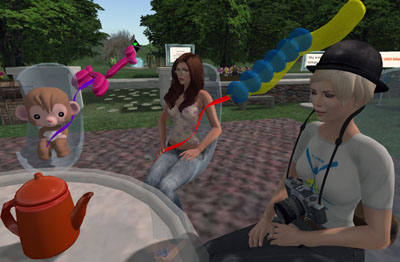
The week prior, I had my creative writing students go on a field trip. They were studying setting in fiction, and I asked them to go find sims that corresponded with their settings they had been creating in stories and poems. One group came back with animal balloons; they had visited a zoo sim and were quite excited about the animals (and balloons) they had discovered.

So I'm still not sure how far I'd want to go with gamification, though I think definitely a sense of play at some level is valuable with learning, and I've found that interaction and fun are definitely valuable with online courses in virtual environments.

There were other excellent sessions, and it was great to hear what has been going on with the Virtual Pioneers and Caledon Oxbridge, but this blog entry has gotten long enough so I think I'll stop here.

One other thing, though--in the process of participating in VWBPE, I learned about, and tried, a couple of other virtual worlds, Edorable and High Fidelity. Both are not ready for prime time (not even for late night) but were intriguing to check out. The developer of Edorable claims that his media board is entirely synchronous, that what the instructor does on the board is seen by the students, just like in a face to face classroom--even with password protected sites. This sounds quite promising!

Now, really, I'm done. I guess that's what you get when I haven't blogged in a while!

Tuesday, June 09, 2015

Virtual Worlds 2.0: High Fidelity and Magic Leap

This morning I watched a couple videos from the MIT Technology Review's EmTech Digital conference that took place on June 1-2 in San Francisco. The first one was with Philip Rosedale--the founder of Second Life--talking about his new-virtual world company High Fidelity: The Quest to Put More Reality in Virtual Reality | EmTech Digital 2015 | MIT Technology Review.

This new version of a virtual world allows for the presentation of facial expressions that match actual facial expressions of the human driver: if you turn your head, smile, blink, blow out your cheeks, your avatar will do the same. It's also going to run on anyone's computer/server with an easy upload and naming of virtual world URLs, low latency (when you say or act, it takes place with no lag to speak of), and will interface with a variety of interfaces, from laptop, to Oculus Rift, to HTC Vive, to HoloLense to Magic Leap. The company is also working on making access to the virtual world beyond the keyboard and mouse. More natural, haptic, using hands to manipulate objects in world rather than coordinating a keyboard and mouse. And it will also have two similarities with Second Life: the capacity to build in world and a marketplace.

He discussed the use of the virtual world in education: "One of the areas we think virtual reality, particularly head mounted displays, is going to have some of its amazing early impact in virtual worlds is in teaching. If teachers can create learning spaces that they can invite students into and those students can look the teacher in the eye and be present and be aware and be attentive we think it's going to have a radical, accelerating impact on the online teaching that we're already doing today." He also mentioned later the idea that teaching and teaching-like experiences will be more immersive, such as having a discussion.

Of course, the sense of presence in an online class is something I've been exploring for several years in Second Life. Would the changes he mentions above add to the immersiveness of a class discussion, the sharing of writing, the participation in field trips or virtual world excursions?

I think so. Especially facial expressions--looking naturally at each other in the virtual environment--would add tremendously. Head-mounted displays would make it so that you could look at each other rather than manipulating mouse and keyboard to have your avatar move its head (which most students don't at all do!).

But that seems down the road a good number of years for most students because of the expense of head mounted displays and other haptic hardware. The biggest issue is latency and smooth, uninterrupted connection to operate the virtual environment. When students have a glitch-free experience, the interaction, social presence, immersiveness is much stronger. When they are constantly fighting lag, slow rezzing, jerky avatar movement and such, then the presence goes out the window.

In the last couple years, the stability of SL and the ability to access it with student computers has been much improved. Adding more tech-heavy stuff, like a head-mounted display, would take us back to glitch-land, at least in the beginning.

But even so, for an online class, students with a head-mounted display would have to be able to operate a keyboard, to be able to type onto a notecard in world. Last month for the first time, I tried the Oculus Rift and found that  the use of the keyboard or mouse was difficult because I couldn't look down to see it. Being able to do so would be necessary, or being able to access a virtual keyboard in world might work.

The other video session I watched from the EmTech Digital conference was about Magic Leap10 Breakthrough Technologies 2015 - Magic Leap. The nearest I understand the product being developed is that it creates virtual images not through stereoscopic head mounted displays (think the old View-Masters) or other 3-D stereoscopic glasses used in 3D movies (in essence how Oculus Rift and other head mounted displays work), but through a light field that is projected onto your eyes, much like how we receive light in the actual world. And the idea is that it can blend imperceptibly with the light of the actual world simultaneously, creating a digital/analog augmented reality.

An augmented reality display, like Magic Leap (or Microsoft's HoloLens) might improve the problem I mentioned above, that of being able to see one's keyboard in order to write, an important necessity for courses that involve lots of writing. But would they keep the sense of presence that a virtual environment offers, blocking out the pile of laundry on the sofa, or the barking dog in the back yard (not that current iterations do a good job with the latter!) The whole idea of presence with the professor and other students in real time in a shared space is what needs to be preserved and even more so enhances with these new ventures into virtual reality, at least when it comes to online education.

Wednesday, September 26, 2012

Summer author interview and the fall semester begins

This summer I published a story cycle of urban fantasy/magical realism, the Annunciation of Jack, which you can purchase on Amazon or Barnes & Noble.

Also, I was interviewed by Alexander Zoltai, who manages events at Book Island in Second Life. Last spring semester, some of my creative writing students attended his book chat and he was intrigued with the work I was doing with students in the virtual world. It was a short interview, but I enjoyed meeting Alexander, and chatting with him.

You can access the interview at https://nfaa.wordpress.com/2012/08/31/author-interview-dan-holt/.

Meanwhile, this semester has been quite a challenge. Everything changed--our department offices, our learning management system, even my virtual space in SL since Angel Learning Isle is no longer being supported by Blackboard. I'm now holding class sessions on MCCAVLC Island (Michigan Community College Association Virtual Learning Collaborative). The director agreed to have Angel Learning Isle in essence moved over, so much is the same, though I had to restore all of the tools I need, from the class area, to my office to the sky areas where I have students do small group work.

The good thing about the move is that I have more administrative rights at MCCAVLC Island (thank you, Ronda Edwards!), so I can send clutter back to owners, I can ban griefers (though I've only had one the entire time I worked on Angel Learning Isle), and my teleporters work when they didn't on Angel Learning Isle.

As I've mentioned before, I use sky platforms for small group work. In a f2f class, if I want students to do an activity in small groups, I'd send them to different corners of the room. In the virtual environment, though, you can't be nearby because text chat or voice bleeds into each other. So I set up sky areas hundreds of meters in the air that are far enough apart so the groups don't hear each other. On each sky area, I have a table, and three media share boards, where students can read my instructions and write with each other on Google Docs.

Before, I had landmark dispensers in my class area, where students would grab a landmark and then teleport to the sky area. I always had a couple students have difficulty with the steps involved. Now, with teleporters, all they have to do is right click and teleport. So starting students up with small groups has been much smoother and quicker. I did, though, have one student have some problems with the teleporter! I ended up going to the sky area and then send her a teleport to join her group.
Anyway, so far, the semester has gone relatively smoothly. Students enjoyed the scavenger hunt where they get used to the virtual environment by riding bikes, parachuting, petting a dog, riding a merry go round, and dancing on Dance, Dance Revolution! Interesting, though, that the most popular tasks  were lying on a lily pad and watching the dolphins play in the water--more than one student commented on how peaceful they felt when doing so.

I've found that making sure students do a scavenger hunt, particularly when they work with a partner, is the quickest way to get them comfortable interacting in the virtual space so that they can concentrate on our school work in future weeks. And also, meeting as a whole class. Small group chat sessions can be effective for some classes later in the semester. But having students meet weekly, like a f2f or hybrid class, really goes a long way to cement them into a viable writing community where they can work together effectively in becoming more substantive writers.

Can such be done in 2D environments like our new learning management system Desire2Learn or through a web conference like Adobe Connect? At some level, yes. But the immersive quality of being in a place (not on a 2D screen of text and video boxes) does something for most of us, helping us to connect with others.

The other night after a class session, one of my students just burst out, "Well, see ya, I've just gotta fly!"

And another quotation from a mother taking first year composition. Her kids were watching her interact with us during class and she started laughing. "My kids say it is not fair I get to go to class like this!"

Nobody ever said that about Angel or Desire2Learn!


Monday, August 27, 2012

Virtual career fair?

I just ran across this article from the Lansing State Journal about a virtual career fair: http://www.lansingstatejournal.com/article/20120827/BUSINESS/308270023/Michigan-online-virtual-career-fair-set-Sept-26?odyssey=nav%7Chead&nclick_check=1

What caught my eye was this passage: "On Sept. 26, Pure Michigan Talent Connect will host the MiVirtualCareerFair, an online event where job seekers and Michigan employers can interact with each other in a live 3D environment." So I went over to the web site at http://www.michiganvirtualcareerfair.com/ to see what this 3D environment was like. You can see a video at http://www.michiganvirtualcareerfair.com/images/TourClip_michigan_attendee.swf?width=910&height=510 that shows you the "3 D environment" which is basically a browser-based 2D site with static web pages of "virtualness." I was hoping to see something like SL, Jokaydia Grid, Cloud Party, Kitely, or Jibe.

There are avatars to speak of, but they don't appear to move, at least they don't in the video, and you'd think that would be a clear selling point of the virtual world (a term used more than once in the video). Instead, it looks like you can click on images or avatars and then read text or engage in a text chat with those in the "the virtual world."

So for those of us familiar with virtual environments like Second Life, this virtual fair, deemed as "the State of Michigan's hottest new way to find exciting jobs," instead looks like a throw back to the early 2000s when I remember seeing one of the first online courses taught at a "virtual campus" with a crude web page of drawn buildings that you could click on to access course materials/activities.

Why is that? First off, it's browser based. So that means most computers/tablets (though sorry iPad, flash is used)/smart phones can access the "virtual world." Second, the learning curve is much less steep than what one first encounters with a truly immersive virtual environment. Pop up text windows, video, text chat, some Skype appear to be used. Even so, the web site includes a 24 page PDF file for job seekers with instructions on how to participate: http://www.michiganvirtualcareerfair.com/adv/Candidate_Guide_Michigan.pdf.

So even though the virtual career fair is not nearly as immersive as some of us are used to, it does point out that the desire to do work in a virtual environment is still alive and well, in spite of the "trough of disillusionment" that virtual worlds seem to be in (see Gartner's most recent report at http://www.gartner.com/it/page.jsp?id=2124315). But the need for ease of use (or as close as you can get for a complex 3D world), and access from typical tech, not just high end, is paramount for use by other than first adopters.

It also shows us that bringing student into virtual worlds--when doing so makes sense given the nature of the class and the nature of delivery--is preparing them for virtual environments that will likely be a part of their work world, if not now, then in the near future. Something very important to colleges and universities right now, especially community colleges.


Sunday, February 26, 2012

When does an online class start?

Over fifteen years ago, while designing the very first online composition course for Lansing Community College, I recall discussing with other faculty working on their first courses to start in Fall 1997 the question of when online classes start.

Today, it seems obvious--when the semester starts. But even so, not such a simple answer. F2f classes have clear, weekly schedules. This section meets on Mondays and Wednesdays from 12-2 p.m., that section meets Thursdays from 6-10 p.m. It's labeled so in the schedule book, on an instructor's assignment page, and now on the web.

But online classes don't have a time listed in the schedule book. All they say is "Arranged." So when do they start? When the professor decides. Students have access to the Angel LMS web site from the first day, but that doesn't mean the professor starts it then. I usually have with online classes the basic pattern of posting assignments on Mondays by 5 p.m., with work for the week to be completed no later than Saturday night--no later than midnight. For all of my online classes, there are real-time meetings, as I've mentioned in earlier postings, using small group chats, and creating a schedule of 3-5 chat sessions for a week based on student schedules.

But with the use of Second Life, I've been experimenting with whole class meetings, where we do meet weekly at a specific time, like a f2f class would do. For this semester, I have creative students meeting with me on Tuesdays from 7-9 p.m. and Comp II students meet with me on Thursdays 7-9 p.m.

It's caused a problem doing so with the schedule book/web listing of the courses. They're still "Arranged" with a note stating when we're meeting. But of course, students are used to seeing day and time listed in a specific spot for f2f and hybrid courses, so when they don't see such for my classes, they don't expect to have to meet at a certain time. I've tried to have administration change this for my classes, but they've not been cooperative, telling me "it's just not done with online classes." Sigh.

Well, I solve the problem by emailing students before the semester starts, so everyone knows what they are getting into well before the semester starts, and those who cannot meet at the scheduled time can drop and go elsewhere.

Anyway, over the last few semesters, I've found a few benefits for meeting as a full class rather than in small group chats.
  1. Second Life orientation goes much smoother when everyone meets at the same time.  I have students do the orientation and a scavenger hunt during week 2. It's much simpler for them to find a partner to work on completing tasks at Angel Learning Isle when they all show up between 7-9 p.m. on a particular evening than throughout the week as happens with sections who meet only in small groups. 
  2. Whole class meetings are more energetic than small group chats. Now, don't get me wrong, small group chats can be quite animated with a rich conversation among well-prepared students. The song sharing I mentioned a couple posts back is an example. But sometimes they are not--especially on Friday afternoons when few are prepared! But when you have a whole class together, even if some aren't prepared, enough are that significant work and learning take place. 
  3. Whole class meetings are easier on me. In the beginning of the semester, I attend every chat. So if I have a class with 5 chat meetings that last from 1-2 hours each, and I have several classes doing so, I can be in world (or online with 2D chats) for up to 24 hours. Now, I do bow out of chats later in the semester by choosing a moderator to keep things going in each group. But even so, it's much easier meeting with everyone, and saying something once rather than five times! A prime example is my creative writing class a couple weeks ago, where I do a lesson on how best to read poems aloud, showing them how to read a poem from sentence to sentence rather than line to line. We talk about nursery rhymes, songs, and literary poems, and I read to them one of their assigned poems to show how much clearer it can be when read from sentence to sentence. In past semesters, I did so three or four times, depending on the number of chat sessions. Last week, only once.
  • Now, I don't tend to choose lessons or class organization based on what's easiest for me. I choose based on what works best for students. But it certainly doesn't hurt if the two coincide. Even more important that they do the older I get!
  1.  Whole class meetings give students much more of a sense of community. It's true that they work with the whole class in Angel discussion forums, and in real time with a small group during chats. But meeting regularly with everyone gives students a sense of being a whole community, rather than isolated individuals or small groups. I'm not sure that such is important for everyone. A good number of students just want to get their work done and move on. But when part of the learning in a writing class is to address an audience in a community of writers, seeing that community regularly surely helps.
The other aspect of meeting regularly with a whole class is the question of whether to meet at the beginning or at the end of a week. It's an issue that arises with hybrid classes, where half or more of the work done in is done online and the other half on campus. So for a four hour class, usually two hours a week are scheduled to meet on campus.

So, I'm doing both this semester: the creative writing class meets at the beginning of their week (Tuesday); the composition II class meets closer to the end of their week (Thursday). The dynamics are different. For the beginning of the week, students are just getting introduced to the work they'll be doing; for later in the week, they're already full steam ahead.

Any benefits for one over the other? I have yet to decide. One of the benefits of having a later meeting is that  I can expect more significant preparation, kind of like chats, where I expect students to come to a session with notes on the reading or writing they're doing. Classes I start early may include later in the week small group chats. But late week meetings, small group chats don't take place.

Either way, I definitely plan to stay with whole class meetings, something that I've not found doable until virtual worlds.

Side note--I finally got shadows to work! Well, more like Linden Lab finally got the viewer to cooperate with my graphics card so I could take snapshots with shadows, ambient occlusion and even depth of field. My frame-rate drops to a crawl, but it's sufficient for pictures. Now if only the Arts & Sciences division will cooperate and grant me a computer upgrade!

Friday, October 31, 2008

PD kerplunks in SL

The last few days I've been concentrating on participating in educational events taking place in Second Life. For example, the Educause conference that took place this week in Orlando, Florida had a couple sessions that were simulcast in SL:


With the first session, which was on assessing the efficacy of SL for educational purposes, there were some serious voice problems where those of us in world really couldn't hear what was being said in Orlando. And apparently, in Orlando, they had a lag between what was taking place in SL compared to real life (RL), so that what they would say in the conference room would take some time before it was broadcast in SL, so they had to ignore what they saw on the screen and just begin talking.

Also, often there was an echo whenever someone spoke, until the RL presenters realized that when they have more than one mike open, echoes abound for us in SL. Furthermore, the RL participants had visuals projected on a screen using Power Point or some such. SL participants also had a screen from which visuals could have been projected. However, there was instead an intro-to-SL video on the screen that started up any time a participant "touched" the screen, so I had to turn off the video player on my screen every time someone started it in order to hear the speaker.

So with all of that, gaining insight from what the RL presenters had to say was very difficult. They did speak about some of the projects they were working on, such as digital story telling, schizophrenia hallucination experiences (sponsored by UC Davis--it's really disturbing!), and roleplaying for dental students (which I explored a little later--below is my avatar sitting in the dentist's chair--scary thought, huh?):


One comment made by a presenter from CU I found really interesting. When the activities in SL are well integrated with the course objectives, its use is well received by students. When it's unclear why they are using SL, how it enhances the work of the course, then students don't like it.

So overall, the session was mildly interesting, given the technical glitches. One disagreement arose about assessing the use of SL differently, or more vigorously, than other educational venues, such as f2f--which I mentioned in-world was often the case between online and f2f. Not discussed was the political reasons for that difference in assessment approach, which often hides attitudes of suspicion that online instructors are loafing, not as effective, or that f2f education is the be all and end all of education.

The second session was a meeting of the Educause virtual world constituents group. It went more smoothly, though the first 20 minutes text chat is filled with people asking how to hear the RL speakers with volunteers helping. Fortunately, such was easy to screen out. The only other problem was that a couple of the speakers had faulty mikes so they had to be skipped over or speak through another avatar's mike.

I won't go over what was talked about--I won't mention that I forgot to take notes!--it was basically introductory information about what different people are doing. I was especially interested in the moderator's work--AJ Brooks--since he teaches comp in SL. But what struck me as most intriguing is the possibility of expanding professional development and conferences. Online conferences have been going on for some time, including experiments in melding both online and f2f. However, being able to participate in a place, with avatars to your right, to your left and in front of you really does add to the experience that conferences in MOOs ("multi user object oriented" text-based real time places) do not have.

It's still very buggy, though, as I've described. I do expect the problems noted will iron out in the next couple years. I'm scheduled to attend an all in-world conference in mid-November, sponsored by East Carolina University. I'll report more fully when it happens--and remember to take notes!

A couple more points. I found an intriguing explanation on Kapps Notes about the value of 3D environments over 2D for educational purposes:

"In a 3D world, the interaction with the students feels more intimate than with a 2-D distance learning application such as Centra, Horizon Wimba or Adobe Connect. One reason is because I can see the personality of the student but, also, there is a sense of presence and connection because two humanoid people are standing face-to-face with proper social distance having a discussion. We are relating as two people as opposed to disembodied names on a screen.

When students talk to me or sit around a table and provide input to the group, it feels as if we are all actually in the same room. We can refer to elements in our environment that we can all see. It is important because it brings together the students from distant geographical areas to one central location where we are actually seeing the same thing and interacting as if we were all in one physical location. Additionally, it is important because I have students work with each other in teams and the closeness of the virtual world helps foster trust among the students and they work well together virtually because they have a sense of one another."

This sense of place and space is what I've found lacking in online education, and why I do think 3D environments are the future for the development.

Karl Kapp also says elsewhere:

"By the end of 2011, 80 percent of active Internet users (and Fortune 500 enterprises) will have a “second life," but not necessarily in Second Life, according to Gartner, Inc. Gartner’s advice to enterprise clients is that this is a trend that they should investigate and experiment with, but limit substantial financial investments until the environments stabilize and mature. "

Obviously what we see here is pure speculation. But with the popularity of immersive video games, an industry very competitive with Hollywood (and by some measures overtaking the movie industry), it stands to reason that 3D environments will become not only popular, but a norm in the online experience in a few years.